
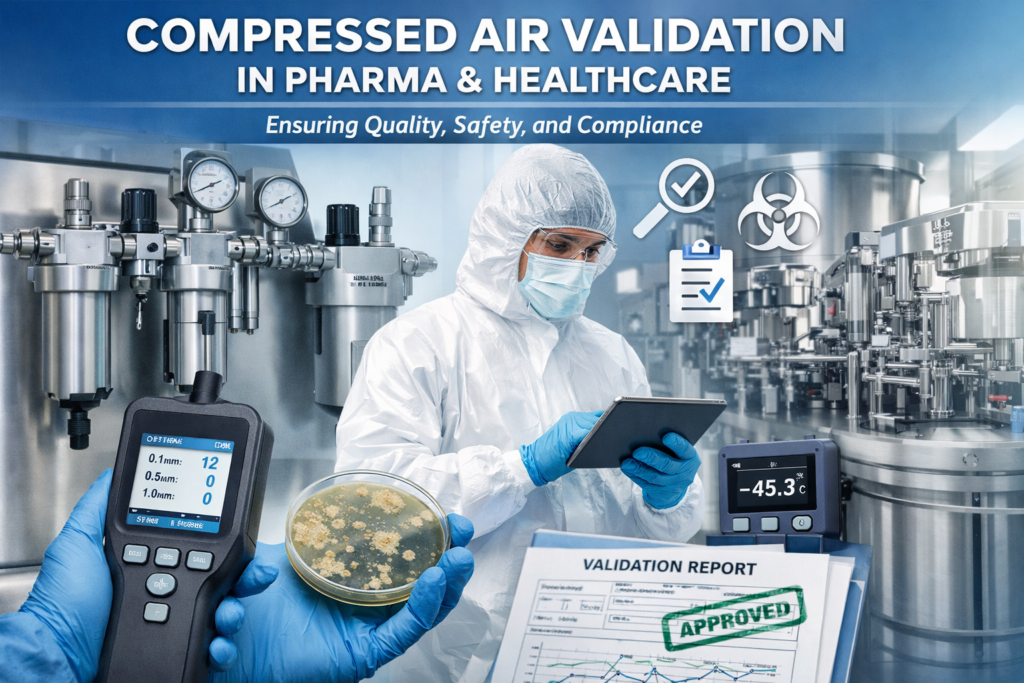
Compressed air is widely used in pharmaceutical, medical device, and healthcare manufacturing processes. It is often referred to as the “fourth utility” after water, electricity, and gas due to its extensive application across production, packaging, and support operations. In many cases, compressed air comes in direct or indirect contact with products, equipment, and primary packaging materials. Therefore, maintaining its quality is critical for ensuring product integrity, patient safety, and regulatory compliance. Any contamination in compressed air—such as oil, moisture, particulate matter, or microorganisms—can lead to serious quality failures, batch rejections, regulatory observations, and costly product recalls.
Despite its importance, compressed air is sometimes underestimated during routine operations. Unlike visible utilities, contamination in compressed air is not always immediately apparent, making systematic validation and monitoring essential in regulated environments.
Why Compressed Air Quality Matters
In the pharmaceutical and healthcare industries, compressed air is considered a critical utility because of its direct impact on product quality. It is commonly used for equipment operation, cleaning and drying of components, filling operations, material transfer, conveying of powders, blister forming, and sometimes even for direct product contact. In aseptic and cleanroom environments, compressed air may also be used to maintain pressure differentials and support critical manufacturing steps.
Poor-quality compressed air can introduce contaminants into controlled environments, compromising both sterile and non-sterile manufacturing processes. Oil aerosols can affect product purity, excess moisture can promote microbial growth, and particulate contamination can lead to visible defects or functional failures. This is why compressed air validation is treated with the same level of importance as other critical utilities such as purified water, water for injection (WFI), and HVAC systems.
Regulatory Expectations and Applicable Standards
Global regulatory authorities such as the WHO, EU-GMP, US FDA, and other international agencies expect pharmaceutical manufacturers to ensure that compressed air used in production is appropriate for its intended application. Although regulations may not always explicitly state numerical limits, they clearly emphasize risk-based control, monitoring, and documentation of utilities that can impact product quality.
The quality ofcompressed air is typically assessed as per ISO 8573, which defines classes for solid particles, moisture (pressure dew point), oil content, and microbial contamination. The required class depends on the specific application—whether the air is used for general plant operations, direct product contact, or aseptic processing. Proper justification of air quality classes, supported by risk assessment, is a key expectation during regulatory audits.
Comprehensive documentation, periodic testing, trending of results, and corrective actions are essential to demonstrate ongoing compliance and system control.
Validation Approach
A structured and systematic validation approach ensures that the compressed air system consistently delivers air of the required quality throughout its lifecycle. The process typically begins with a detailed system understanding, including compressor type, air treatment components, distribution network, and user points.
Risk assessment plays a crucial role in identifying critical points where air quality could be compromised. Based on this assessment, a scientifically justified sampling plan is developed. Testing is carried out at representative user points under defined operating conditions.
Key parameters evaluated during validation include particulate matter, pressure dew point (moisture), oil vapor and aerosols, and microbial load. All testing is performed using calibrated and qualified instruments to ensure the accuracy and reliability of results. A well-executed compressed air validation program helps organizations demonstrate control, consistency, and compliance during internal reviews and regulatory inspections.
Benefits of Regular Validation and Monitoring
Regular validation and routine monitoring of compressed air systems offer multiple operational and quality benefits. First, it significantly reduces the risk of product contamination and associated quality failures. Second, it improves overall process reliability by identifying potential issues such as filter degradation, moisture carryover, or system leakages at an early stage.
Proactive monitoring helps prevent unexpected equipment downtime and supports preventive maintenance planning. From a regulatory perspective, consistent validation practices strengthen audit readiness and reduce the likelihood of observations related to utility control. Most importantly, compressed air validation supports a strong quality culture by reinforcing the organization’s commitment to patient safety and compliance with GMP requirements.
Conclusion
Compressed air is often an invisible utility, but its impact on pharmaceutical and healthcare manufacturing is substantial. Treating it as a critical utility and validating it periodically ensures safe operations, consistent product quality, and regulatory compliance. A robust validation and monitoring program not only fulfills regulatory expectations but also enhances operational efficiency and risk management. Investing in proper validation is not merely a compliance activity—it is a proactive step toward long-term quality assurance and operational excellence.